A new NYT Connections puzzle appears at midnight each day for your time zone – which means that some people are always playing 'today's game' while others are playing 'yesterday's'. If you're looking for Monday's puzzle instead then click here: NYT Connections hints and answers for Monday, October 26 (game #1233).
Good morning! Let's play Connections, the NYT's clever word game that challenges you to group answers in various categories. It can be tough, so read on if you need Connections hints.
What should you do once you've finished? Why, play some more word games of course. I've also got daily Strands hints and answers and Quordle hints and answers articles if you need help for those too, while Marc's Wordle today page covers the original viral word game.
SPOILER WARNING: Information about NYT Connections today is below, so don't read on if you don't want to know the answers.
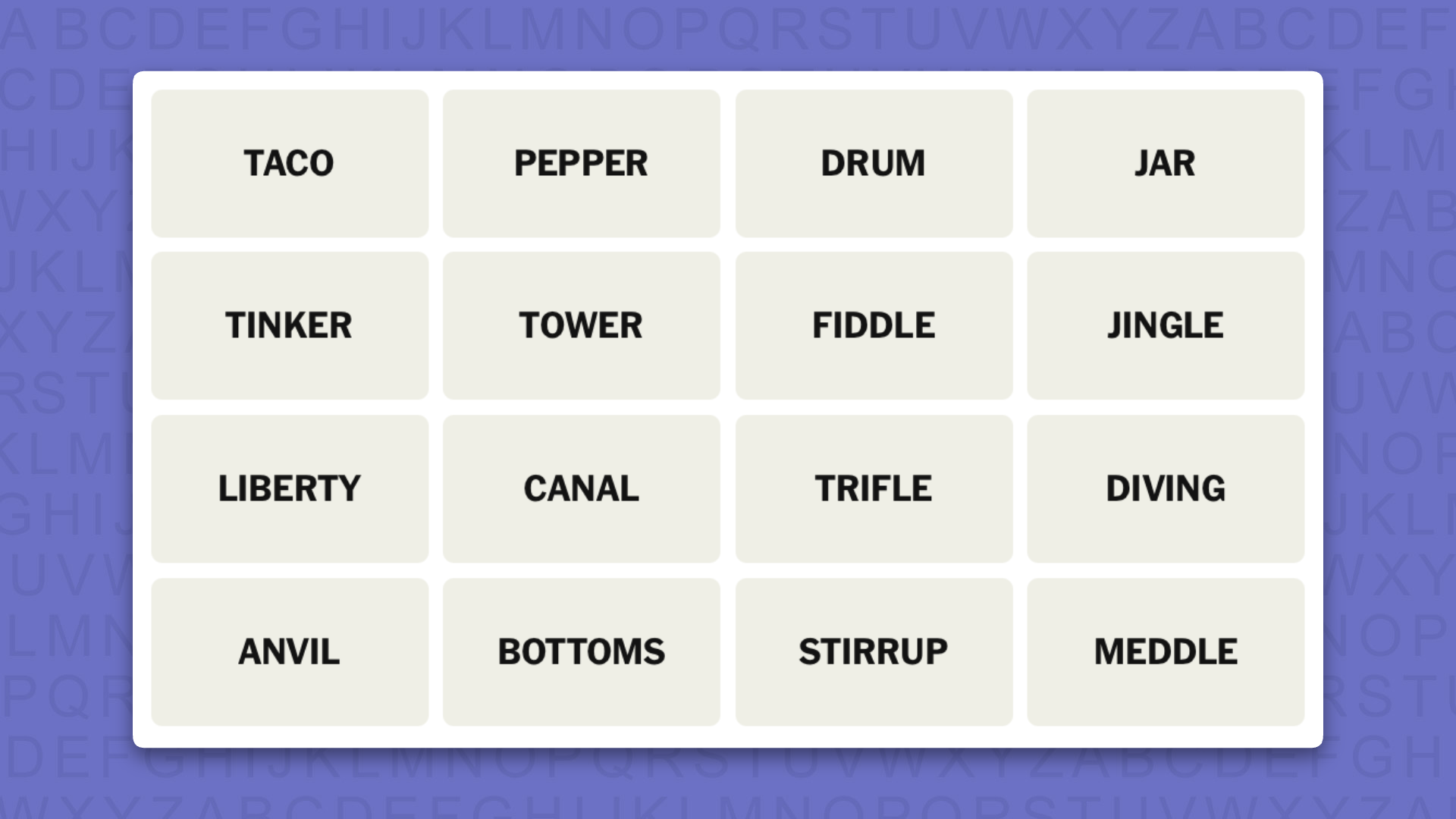
NYT Connections today (game #1234) - today's words
(Image credit: New York Times)
Today's NYT Connections words are…
TACO
PEPPER
DRUM
JAR
TINKER
TOWER
FIDDLE
JINGLE
LIBERTY
CANAL
TRIFLE
DIVING
ANVIL
BOTTOMS
STIRRUP
MEDDLE
NYT Connections today (game #1234) - hint #1 - group hints
What are some clues for today's NYT Connections groups?
YELLOW: Fidget with an object
GREEN: Aural anatomy
BLUE: End with a thing you ring
PURPLE: Start with a thing you ring
Need more clues?
We're firmly in spoiler territory now, but read on if you want to know what the four theme answers are for today's NYT Connections puzzles…
NYT Connections today (game #1234) - hint #2 - group answers
What are the answers for today's NYT Connections groups?
YELLOW: MESS (WITH)
GREEN: PARTS OF THE EAR
BLUE: _____BELL
PURPLE: BELL_____
Right, the answers are below, so DO NOT SCROLL ANY FURTHER IF YOU DON'T WANT TO SEE THEM.
NYT Connections today (game #1234) - the answers
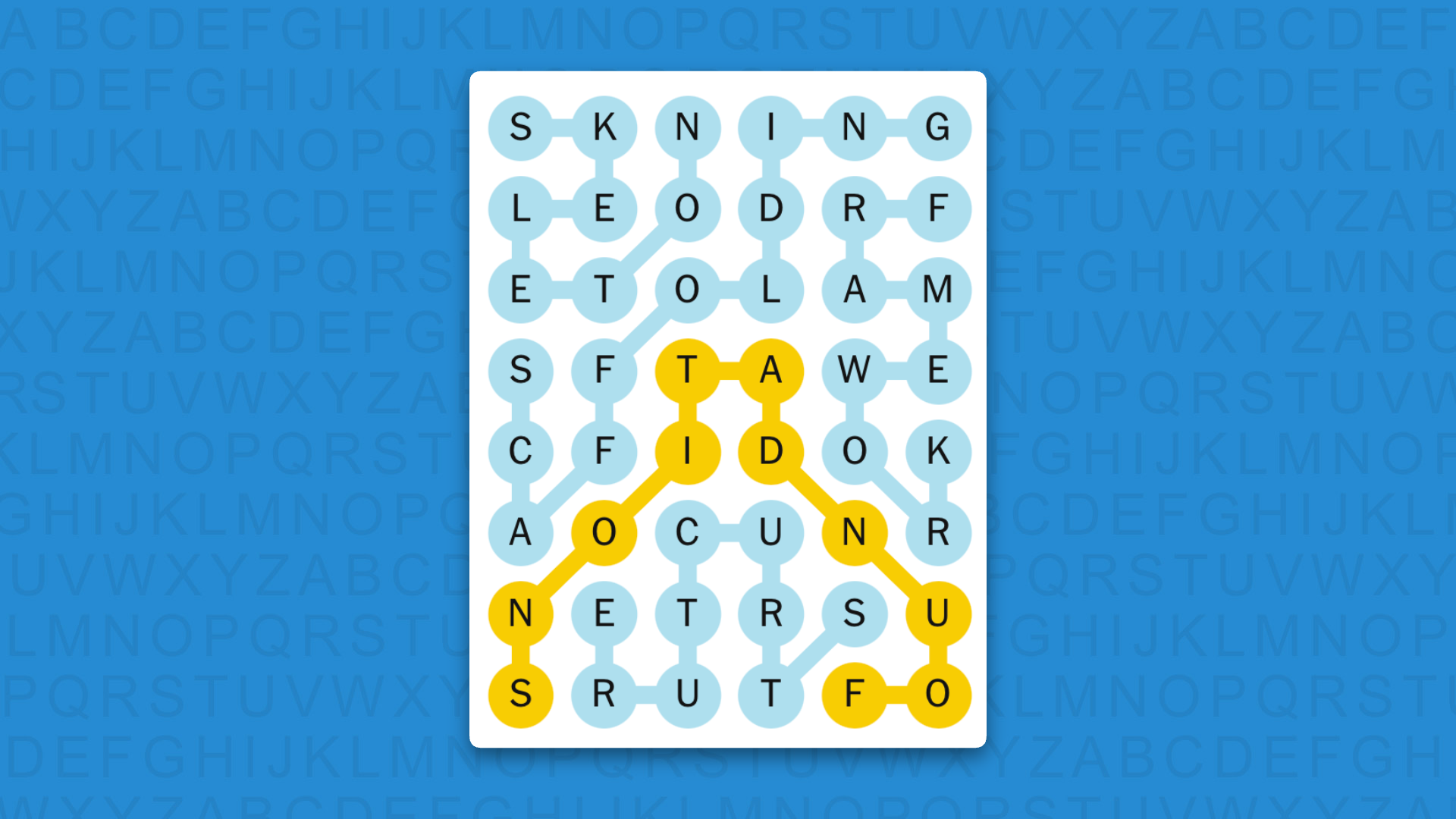
(Image credit: New York Times)
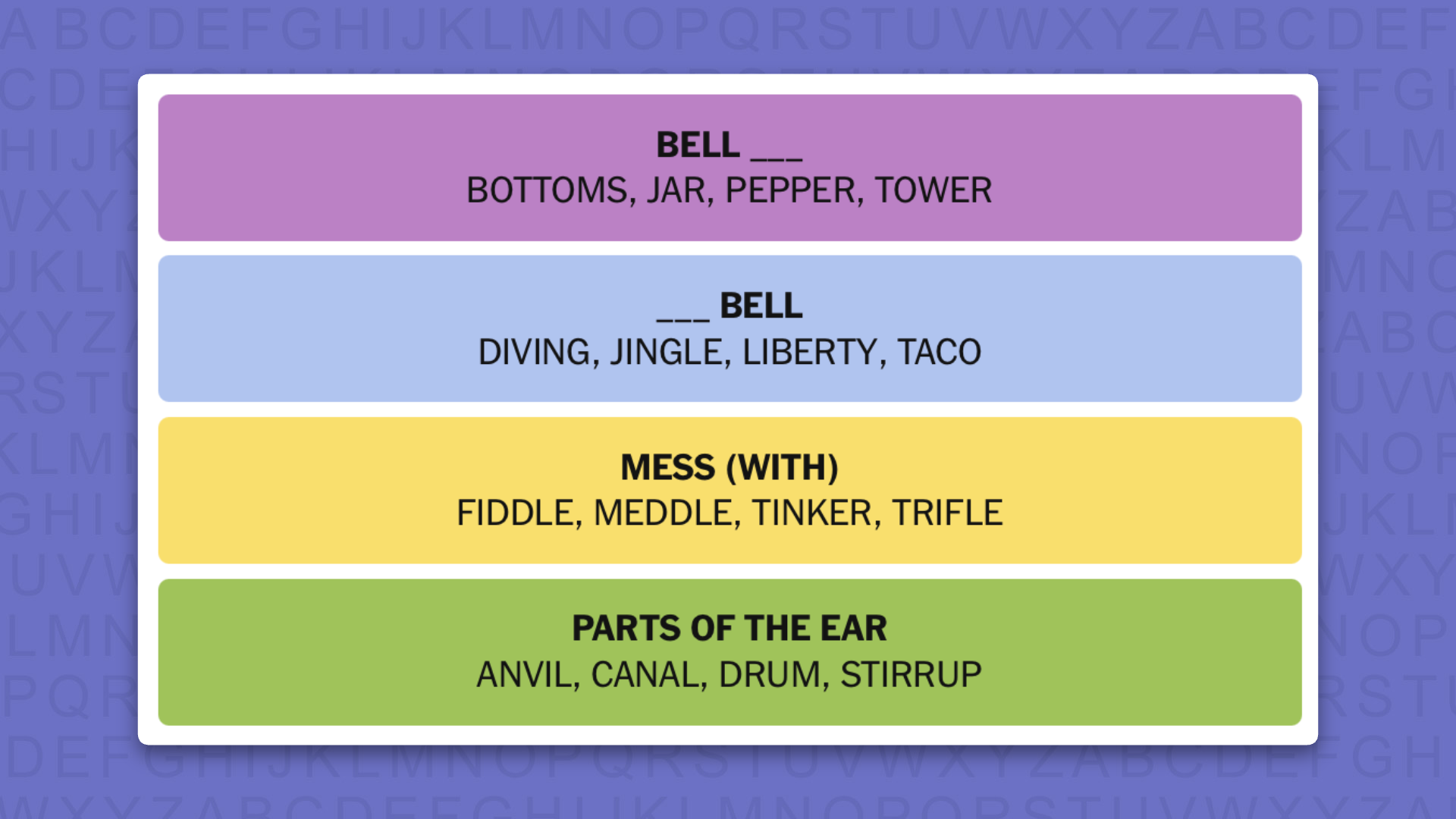
The answers to today's Connections, game #1234, are…
GREEN: PARTS OF THE EAR: ANVIL, CANAL, DRUM, STIRRUP
BLUE: _____BELL: DIVING, JINGLE, LIBERTY, TACO
PURPLE: BELL_____: BOTTOMS, JAR, PEPPER, TOWER
My rating: Hard
My score: 3 mistakes
When I am on a mission with a Connections group I find it hard to stop myself until I’ve finally got it.
It took me four guesses to get the four tiles that made up ______BELL, because I kept including TINKER — a situation that could have been easily resolved if I’d spent some time looking at the connections that didn’t involve bells.
Annoying, but on a more positive note landing the four tiles that began with BELL won me a Purple First.
Yesterday's NYT Connections answers (Monday, October 26, 2026, game #1233)
YELLOW: RESPONSES TO "HOW ARE YOU?": CHILLING, MANAGING, NOT BAD, SAME OLD
GREEN: KINDS OF MATS: PRAYER, WELCOME, WRESTLING, YOGA
BLUE: AKC DOG BREED GROUPS: HERDING, HOUND, SPORTING, TOY
PURPLE: HORROR MOVIES WITH LAST LETTER CHANGED: HALLOWEEK, HOSTED, JAWN, PSYCHS
What is NYT Connections?
NYT Connections is one of several increasingly popular word games made by the New York Times. It challenges you to find groups of four items that share something in common, and each group has a different difficulty level: green is easy, yellow a little harder, blue often quite tough and purple usually very difficult.
On the plus side, you don't technically need to solve the final one, as you'll be able to answer that one by a process of elimination. What's more, you can make up to four mistakes, which gives you a little bit of breathing room.
It's a little more involved than something like Wordle, however, and there are plenty of opportunities for the game to trip you up with tricks. For instance, watch out for homophones and other word games that could disguise the answers.
It's playable for free via the NYT Games site on desktop or mobile.
from Latest from TechRadar US in Gaming News https://ift.tt/Ierb3hm
via TECHNICAL SAFEER
A new NYT Strands puzzle appears at midnight each day for your time zone – which means that some people are always playing 'today's game' while others are playing 'yesterday's'. If you're looking for Sunday's puzzle instead then click here: NYT Strands hints and answers for Sunday, October 25 (game #966).
Strands is the NYT's latest word game after the likes of Wordle, Spelling Bee and Connections – and it's great fun. It can be difficult, though, so read on for my Strands hints.
Want more word-based fun? Then check out my NYT Connections today and Quordle today pages for hints and answers for those games, and Marc's Wordle today page for the original viral word game.
SPOILER WARNING: Information about NYT Strands today is below, so don't read on if you don't want to know the answers.
NYT Strands today (game #967) - hint #1 - today's theme
What is the theme of today's NYT Strands?
• Today's NYT Strands theme is… Please, be my guest!
NYT Strands today (game #967) - hint #2 - clue words
Play any of these words to unlock the in-game hints system.
POSH
VITALITY
HONEST
COVE
VINE
THERE
NYT Strands today (game #967) - hint #3 - spangram letters
How many letters are in today's spangram?
• Spangram has 11 letters
NYT Strands today (game #967) - hint #4 - spangram position
What are two sides of the board that today's spangram touches?
• First side: top, 4th column
• Last side: bottom, 1st column
Right, the answers are below, so DO NOT SCROLL ANY FURTHER IF YOU DON'T WANT TO SEE THEM.
NYT Strands today (game #967) - the answers
(Image credit: New York Times)
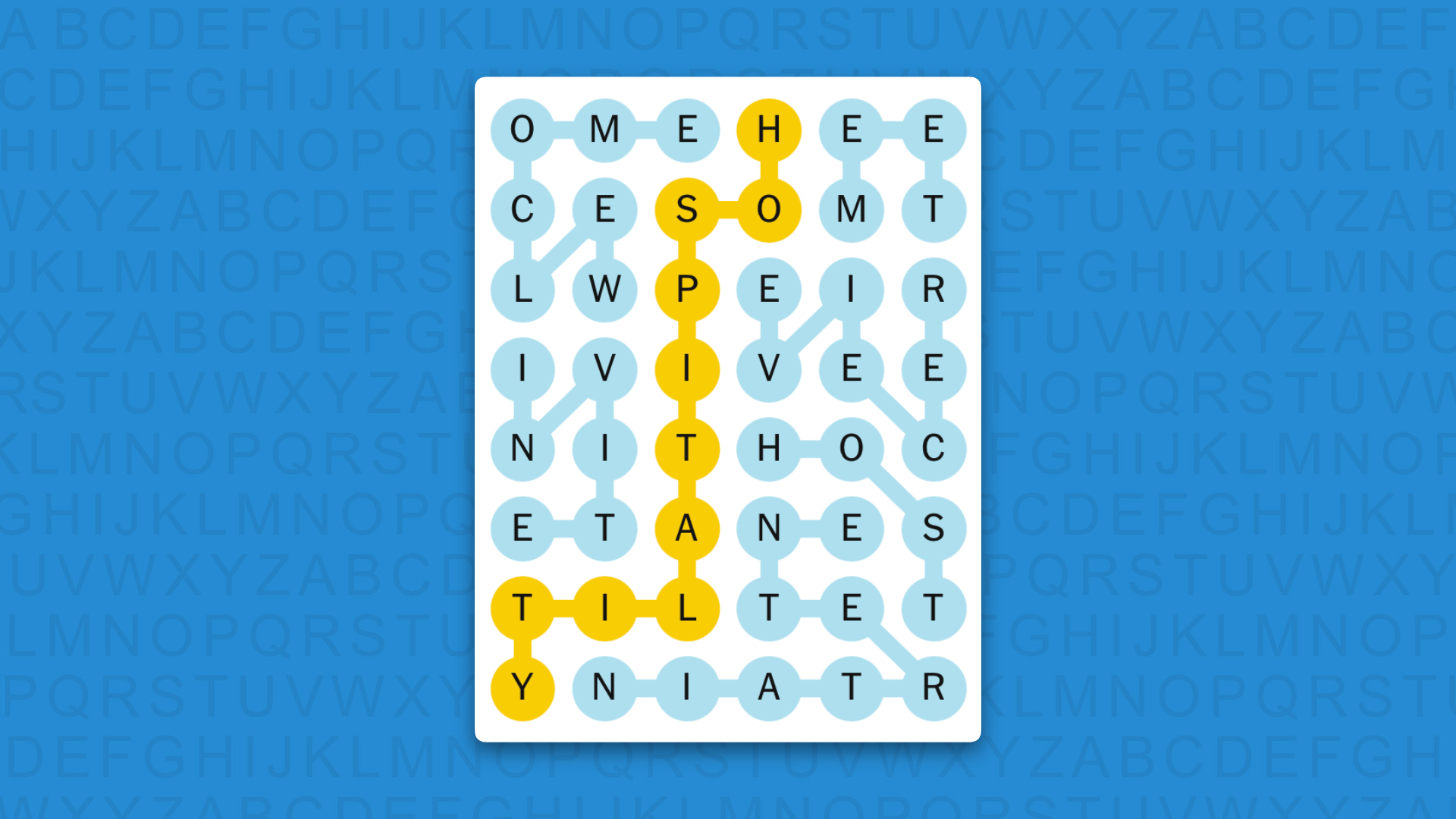
The answers to today's Strands, game #967, are…
WELCOME
HOST
MEET
INVITE
RECEIVE
ENTERTAIN
SPANGRAM: HOSPITALITY
My rating: Hard
My score: 1 hint
My head was absolutely not in the game (as they used to say in High School Musical) today.
I say this just in case I have made an easy game far more difficult than it was. I think I lost heart after thinking I’d found a spangram with welcomehome, and getting really disappointed when WELCOME was just a regular game word.
Even with this vital piece of information about the type of words we were looking for (my first thought when I saw today’s theme was the song Be Our Guest from Beauty and the Beast) I still needed a hint to kick me onwards.
Yesterday's NYT Strands answers (Sunday, October 25, game #966)
SCAFFOLDING
FRAMEWORK
STRUCTURE
SKELETON
SPANGRAM: FOUNDATIONS
What is NYT Strands?
Strands is the NYT's not-so-new-any-more word game, following Wordle and Connections. It's now a fully fledged member of the NYT's games stable that has been running for a year and which can be played on the NYT Games site on desktop or mobile.
I've got a full guide to how to play NYT Strands, complete with tips for solving it, so check that out if you're struggling to beat it each day.
from Latest from TechRadar US in Gaming News https://ift.tt/tVEYxQ2
via TECHNICAL SAFEER
Sen. Ron Wyden wants CISA and OMB to require Encrypted Client Hello on federal websites and make it a federal contract condition
His list of 350 CDN-hosted addresses without ECH includes the FBI tip portal, the VA's crisis line, and hotlines for whistleblowers and civil rights complaints
ECH hides site names only alongside encrypted DNS, does nothing for server breaches, and is already blocked in Russia, where some listed embassy pages are aimed
US Senator Ron Wyden (D-Ore.) wants the federal government to turn on a privacy feature that major web browsers have supported for three years, warning that hundreds of agency web addresses still broadcast the name of the site each visitor uses to anyone watching the network along the way.
In a letter to CISA acting director Nick Andersen and deputy federal chief information officer Thomas Flagg, Wyden asked the two agencies to require Encrypted Client Hello (ECH) across federal websites and to make ECH support a condition for cloud and network vendors seeking federal contracts.
The letter attaches a list of 350 executive branch web addresses that use content delivery networks (CDNs) but do not use ECH, while requesting an unclassified response and action plan by November 20 2026.
The one thing HTTPS leaves in the open is the gap being addressed here
Almost every federal site now encrypts the pages people read and the forms they submit. Standard HTTPS does not hide the hostname. When a browser opens a secure connection, it announces the site it wants in a field called Server Name Indication, in plain text, before encryption begins.
An internet provider, a hostile Wi-Fi network, or a compromised telecom carrier can therefore log that a connection went to tips.fbi.gov without reading a word of the tip itself.
ECH encrypts that part of the handshake. It works best behind a large CDN, where thousands of unrelated sites share the same front door. Cloudflare's implementation, for example, presents every ECH-protected site to the network under one shared name, so an observer can tell a visitor is reaching a Cloudflare-hosted site, but not which one.
Wyden's letter singles out two services. The Department of Veterans Affairs' online suicide prevention service at veteranscrisisline.net is hosted on Amazon Web Services, which the letter says does not currently support ECH. The FBI's tip portal at tips.fbi.gov runs on Cloudflare, which does, but the bureau has not turned it on yet, as Wyden noted, stating: "For the federal domains using a CDN provider with ECH support, such as Cloudflare, turning on domain protection merely requires a configuration update."
191 of the 350 addresses, or 54.6%, are diplomatic: 174 embassy sites, three consulates, and 14 missions, mostly to international bodies such as NATO and the UN. Another 53 are subdomains of bie.edu, the Bureau of Indian Education's domain, which appear to be individual school sites. A further 12 are test, training, or staging hosts, including several user acceptance testing subdomains for Education Department debt services.
That leaves 94 addresses outside those groups, and the most troubling entries sit there; they include the DHS inspector general's complaint hotline, the Justice Department's civil rights reporting portal, the intelligence community's job application site, a USCIS tip form, the State Department's Rewards for Justice site, an NIH alcohol treatment navigator, a CDC doxy-PEP site, several federal HIV information sites, and ICE's detainee locator.
Cloudflare's documentation says ECH is enabled by default on Free zones, while customers on other plans must switch it on themselves. That fits the spokesperson's finding: a paying government customer has to opt in. For the FBI, the fix really is a setting.
For the VA, it is not. If Amazon's CDN does not offer ECH, the agency would need to change providers or wait. This is where Wyden's second request, making ECH support a condition of federal contracts, gets complicated.
A procurement rule written today would, in practice, favor a very small pool of providers until others catch up. That may be the intent, since it pressures Amazon and its rivals, but it may be as much a market lever as a security fix, at least in the short term.
ECH does have its limitations, however: the protocol's own specification warns that the destination can still leak through plaintext DNS lookups or the server's IP address. Google made the same point when Android 17 added system-wide ECH in August, saying the feature works "in tandem with private DNS to obscure the domain names you visit."
To reiterate, agencies can enable ECH on their side, but they cannot make a veteran on home broadband use encrypted DNS, therefore leaving the door open to exploitation by someone snooping on the network.
A bigger problem is also international coverage. Many of the highlighted URLs are embassies such as ru.usembassy.gov, by.usembassy.gov, cn.usembassy.gov, and ir.usembassy.gov, all of which arguably have users connecting from relatively hostile networks.
For an embassy page, enabling ECH could mean trading a visible hostname for an unreachable site in the country where the hostname matters most, making it a difficult tradeoff with only one real solution: skipping ECH for now.
None of this is new territory for Wyden. In October 2018, he wrote to DHS's Chris Krebs urging agencies to adopt encrypted DNS and Encrypted SNI, ECH's predecessor, and asking DHS to work with GSA on making ESNI a condition for CDN vendors selling to the government.
He called that "the next logical step" after DHS's 2017 HTTPS directive, BOD 18-01. The 2026 letter cites the same directive and describes its requests as "the next logical steps." His record on these letters is mixed rather than hopeless. A 2018 HTTPS letter to the Pentagon was followed by a Defense Department plan to secure its websites.
The client side is ready: most major browsers have supported ECH since October 2023, per the letter, and Android 17 now applies it system-wide. The FBI fix is cheap and overdue. But ECH narrows what a passive eavesdropper learns rather than making a visit invisible, and whether this request outlasts the last one may depend less on CISA and OMB than on whether Amazon and others join Cloudflare.
from Latest from TechRadar US in Computing News https://ift.tt/BsC2tVw
via
Canon recently unveiled its new Dual Pixel 3D, or DP3D for short — an image generation technology making use of Canon’s proprietary Dual Pixel AF technology. The new technology piggybacks off Canon’s proprietary Dual Pixel AF technology found in many of its EOS mirrorless cameras, which splits each pixel on the camera sensor into two separate light-sensitive photodiodes.
This tech has delivered reliable and snappy autofocus in recent years — if the two images on each photodiode line up perfectly, the image is in focus, if they don’t line up then the camera knows which direction to move the autofocus motor to rapidly lock on.
Canon's proprietary Dual Pixel AF technology means each pixel is made up of two photodiodes - the technology is now being used to create 3D photos and video (Image credit: Canon)
The new Dual Pixel 3D feature can be used to create immersive three-dimensional images via Canon’s new Dual Pixel 3D Converter app which was released in October.
While launched in tandem with the hotly-anticipated Canon EOS R8 Mark II on September 16 — a full-frame which makes use of the new feature — it’s good news for owners like myself of any Canon EOS mirrorless camera with Dual Pixel AF, stretching back to older generation models such as the EOS R5 and EOS R6 Mark II, which will be able to benefit without a firmware update (although updating the firmware is always a good idea to stay up date with the latest features and bug fixes).
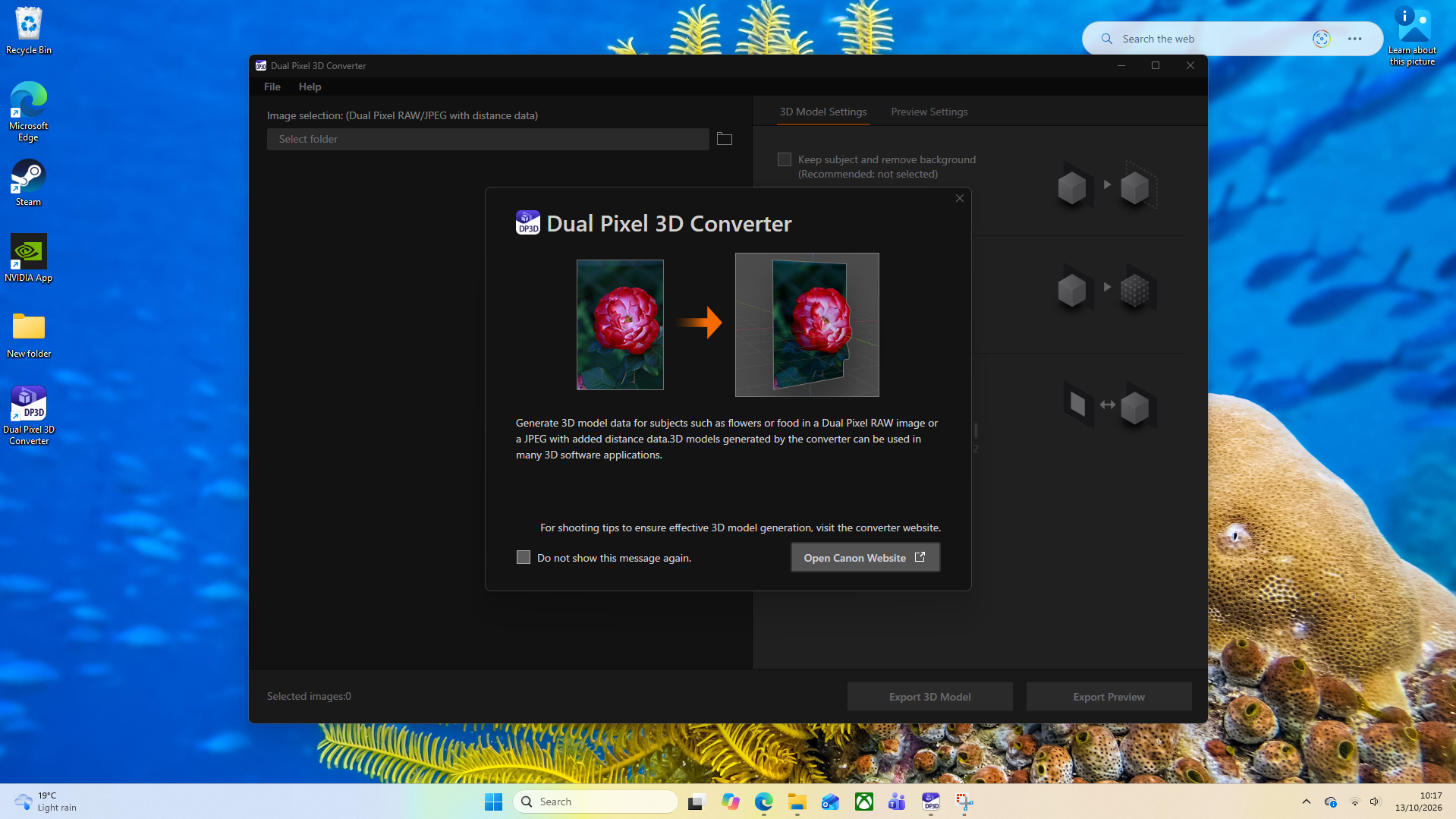
I downloaded the Canon Dual Pixel 3D Converter app to put it through its paces — here’s everything you need to know to get started…
How to take photos for Canon DP3D
To begin, you’ll need a Canon EOS camera with Dual Pixel AF. It’s safe to say if you own one of Canon’s interchangeable lens mirrorless cameras in recent years, then your camera will likely feature Dual Pixel AF and be able to make use of this new tech.
This is great news for users of older Canon mirrorless cameras like myself as my older EOS R5 and previous generation Canon EOS R6 Mark II will still be able to make full use of this brand-new technology.
Your camera will, however, also need to be paired with one of the compatible Canon RF lenses. The list goes beyond specialist Canon RF 5.2mm F2.8L Dual Fisheye or RF-S 3.9mm F3.5 Dual Fisheye, but it is a little limited and also won't currently work with older EF or EF-S glass. We published a full list of compatible Canon cameras and lenses that you can use to enjoy this new technology when it was first announced.
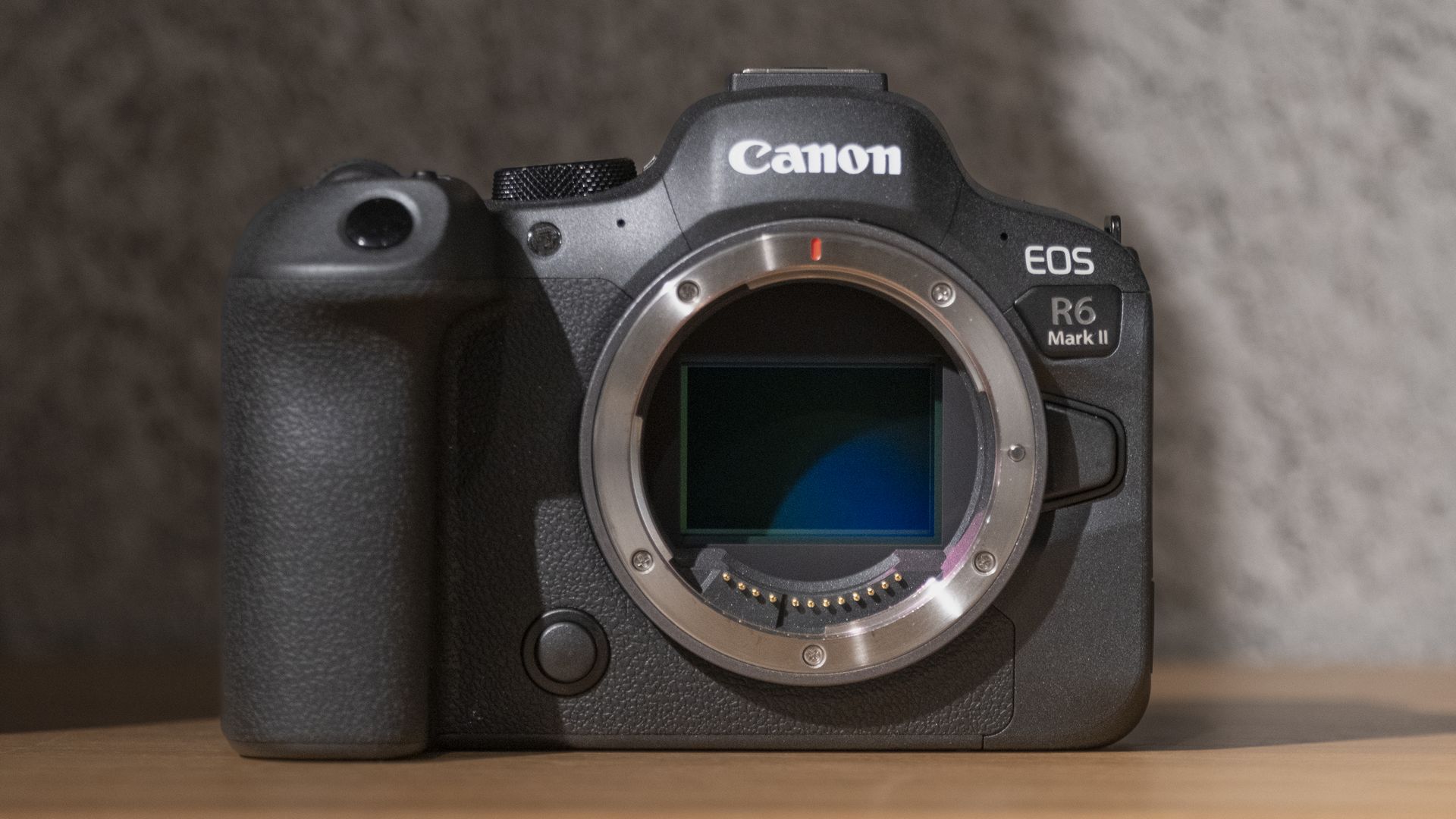
Most modern Canon cameras, such as the EOS R6 Mark II pictured, will be able to produce the Dual Pixel RAW files needed to create the 3D results in DP3D (Image credit: Future)
Canon says, “Specific shooting conditions and techniques are necessary to generate accurate depth information to eliminate blind spots, allow for the required depth of field, subject and background separation, subject depth and surface texture.”
In my experience the software works best when your subject is taken on a clean background (no bokeh) and without too many blind spots which make it harder for the software to create its 3D effect.
You also want an object that’s relatively flat with not too much depth; little bumps are fine such as small pieces of fruit on a tart, but large peaks in depth will cause more significant issues and make the effect much more noticeable and fake-looking.
Two of the compatible lenses Canon lists are the Canon RF 100mm f2.8L Macro IS USM and Canon RF 35mm f1.8 IS Macro STM, both of which are macro lenses. Yet, when I shot with both of these I later got an alert in DP3D warning me for shooting too close to my subject! The result still turned out fine, though.
(Image credit: Canon)
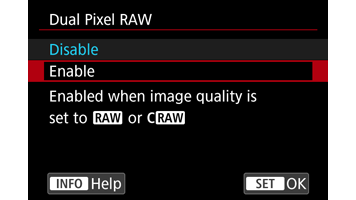
To use the new software you’ll need to make sure you’re shooting not only in the RAW format, but Canon's Dual Pixel RAW (see above). This setting was found in the very first camera menu on my Canon EOS R6 Mark II.
Note that shooting Dual Pixel RAW will produce files roughly twice the size, take longer to write to your memory card, and can't be taken when using the electronic shutter.
Alongside 3D, Dual Pixel RAW can be useful for correcting minor parallax error, shifting bokeh or focus and reducing flare, but if you don't intend to utilize these capabilities within Canon's DPP, I would suggest turning it off when you don't need it to avoid compromizing the camera's performance.
Make sure your subject and focal point are in focus and that your shutter speed is fast enough to shoot handheld – if you’re in doubt shoot on a tripod. You’ll also want to make sure your exposure is correct so that the image isn’t too bright or dark. Canon recommends you don’t close the aperture down past f/5.6 and also keep the camera's sensitivity under ISO 1600 – a warning sign will be displayed on your image when you import it into DP3D otherwise and you won’t get optimal 3D results.
Installing the Canon DP3D app on Windows 11
With the image taken it’s time to open up the new Canon Dual Pixel 3D Converter app, which is currently only available for Windows PC running the latest Windows 11 operating system. Read our guide on How to plan a smooth Windows 10 to Windows 11 migration.
Canon also added “The application will initially be available free of charge”, though specifications and terms of use may change in the future – in other words, it’s initially free but you might need to pay to use it in the future.
(Image credit: Dan Mold)
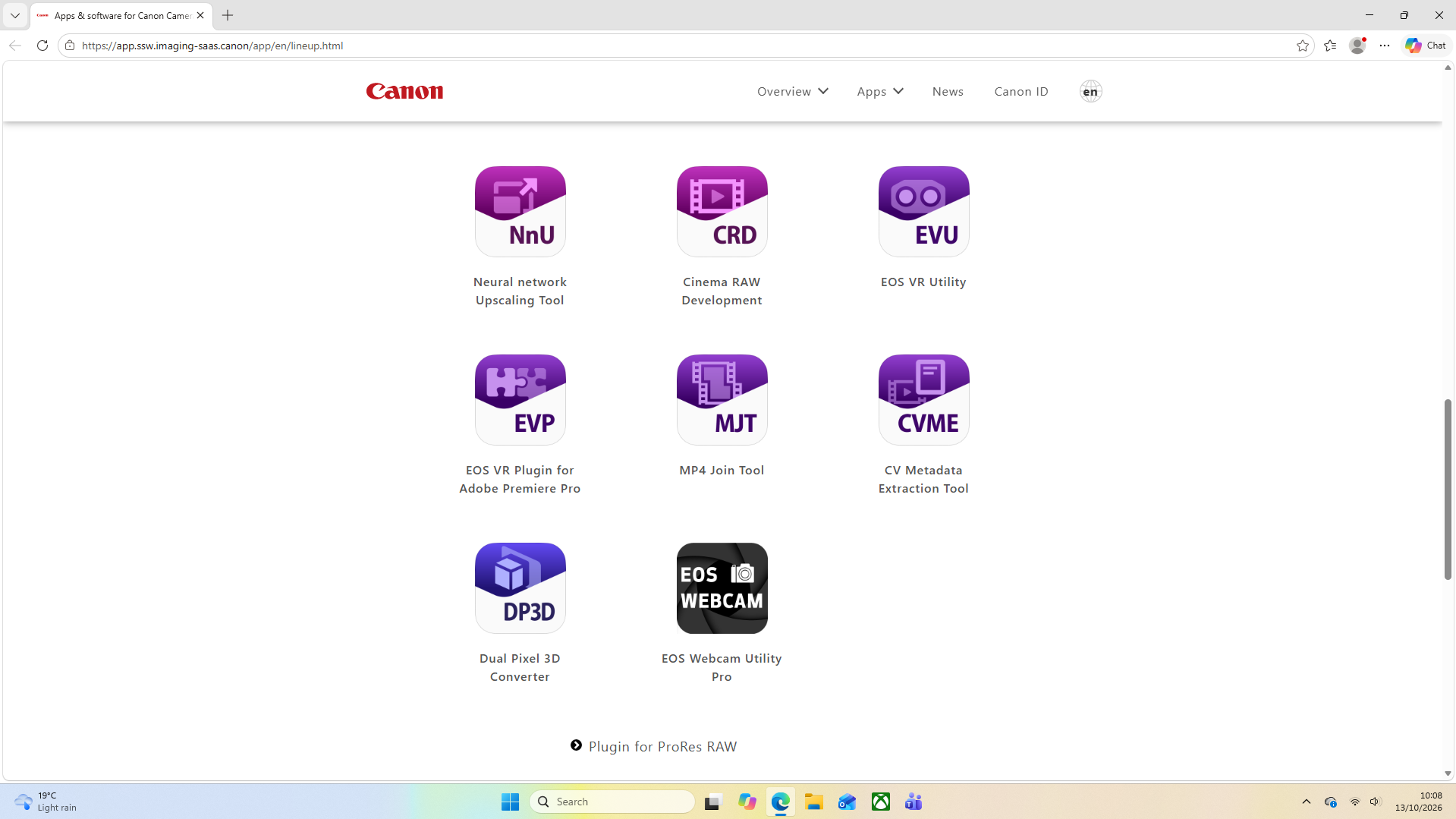
When you're up and running with Windows 11 you’ll be able to run the installation wizard which can be downloaded from Canon’s site. Make sure that once downloaded you extract the ZIP file and then double-click the DP3dInstaller-W1.0.0.13.exe file from the unzipped folder to begin the installation.
Dan MoldDan Mold
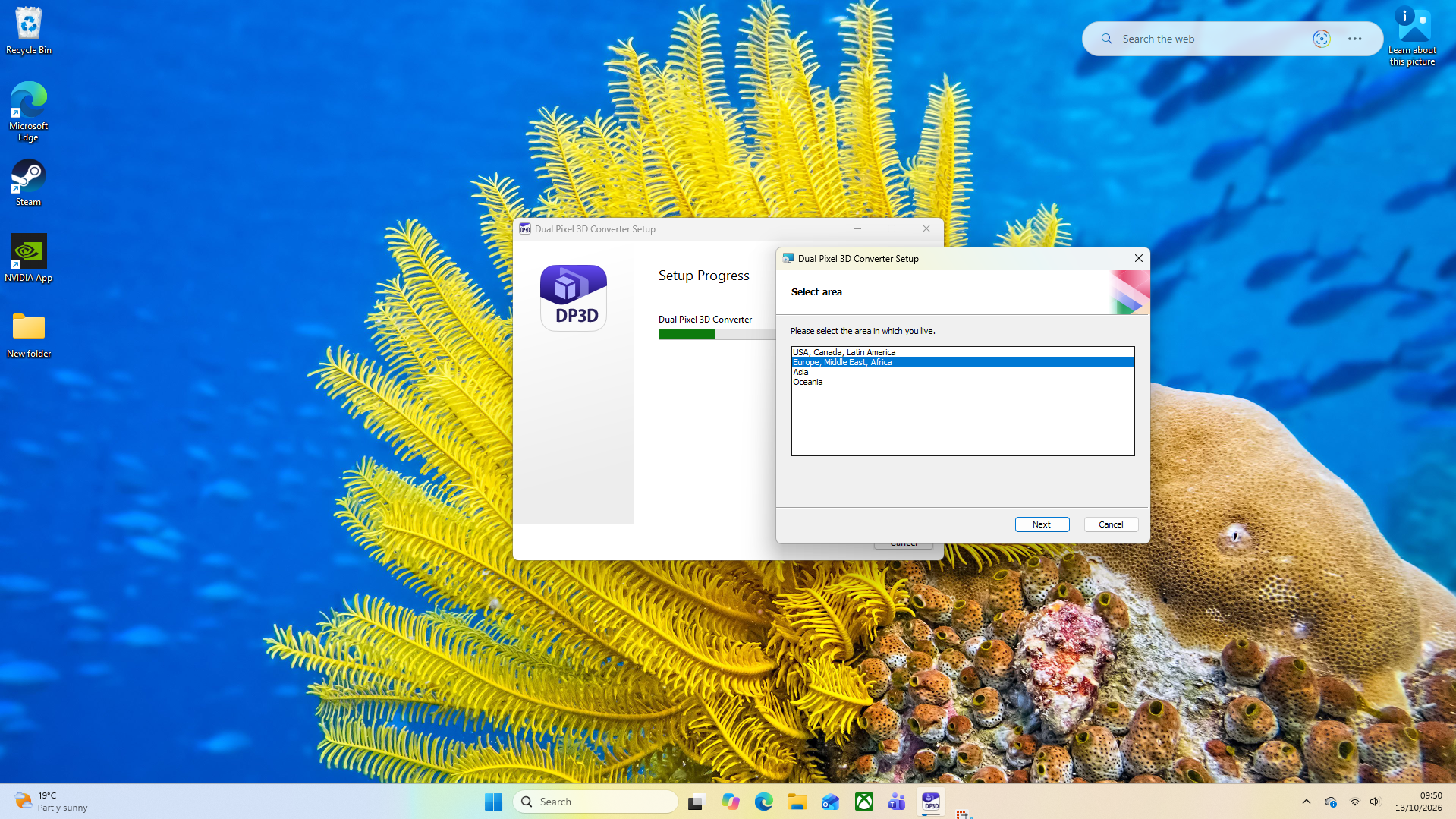
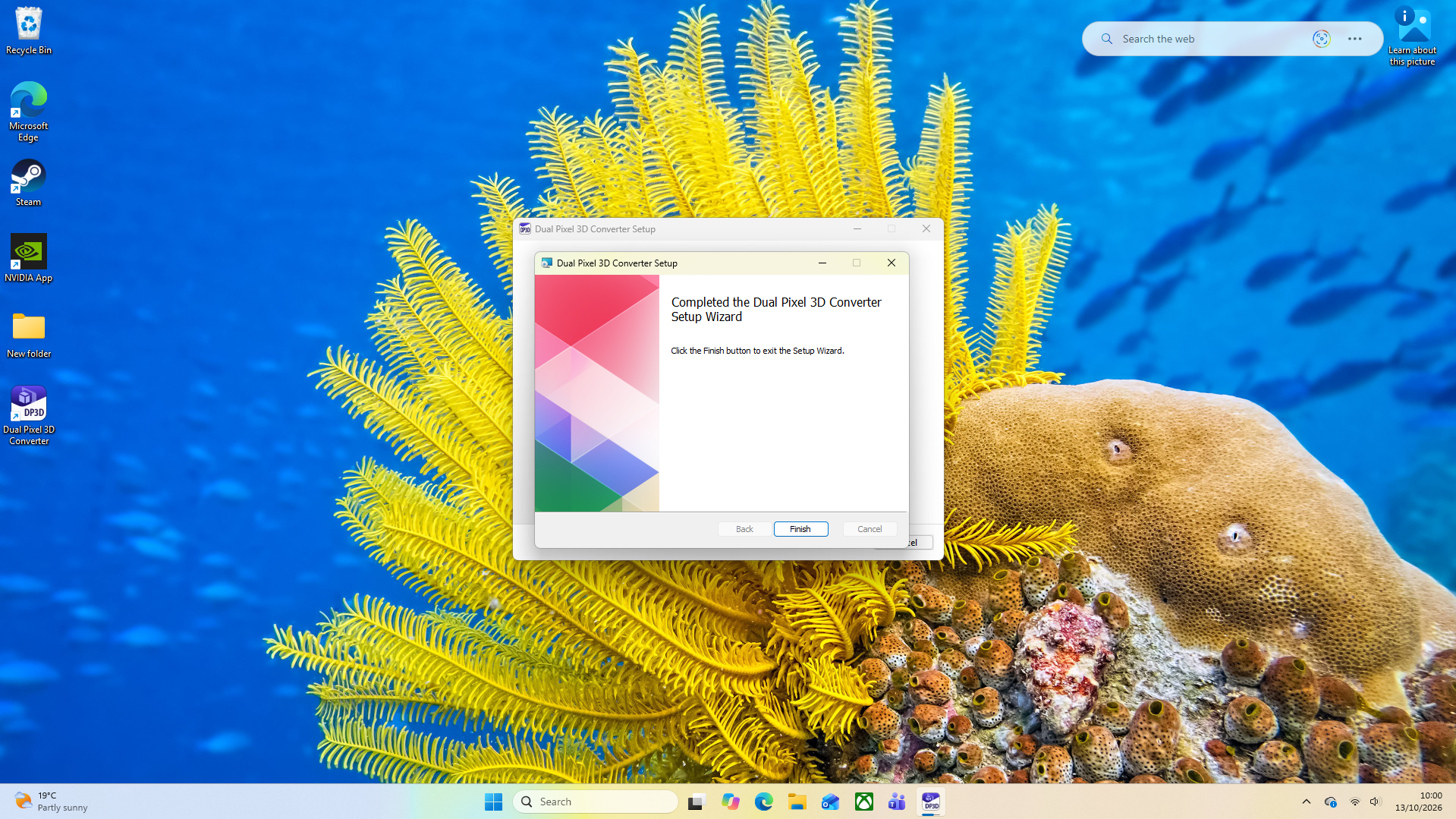
Now you’ll need to choose which area you live in - you have the options: USA, Canada, Latin America, Europe, Middle East, Africa, Asia and Oceania. In the following screen you can choose the country you live in and also select your language. Once you’ve ticked the box to accept the license agreement you can hit next which takes you to the final setup screen, click Install here.
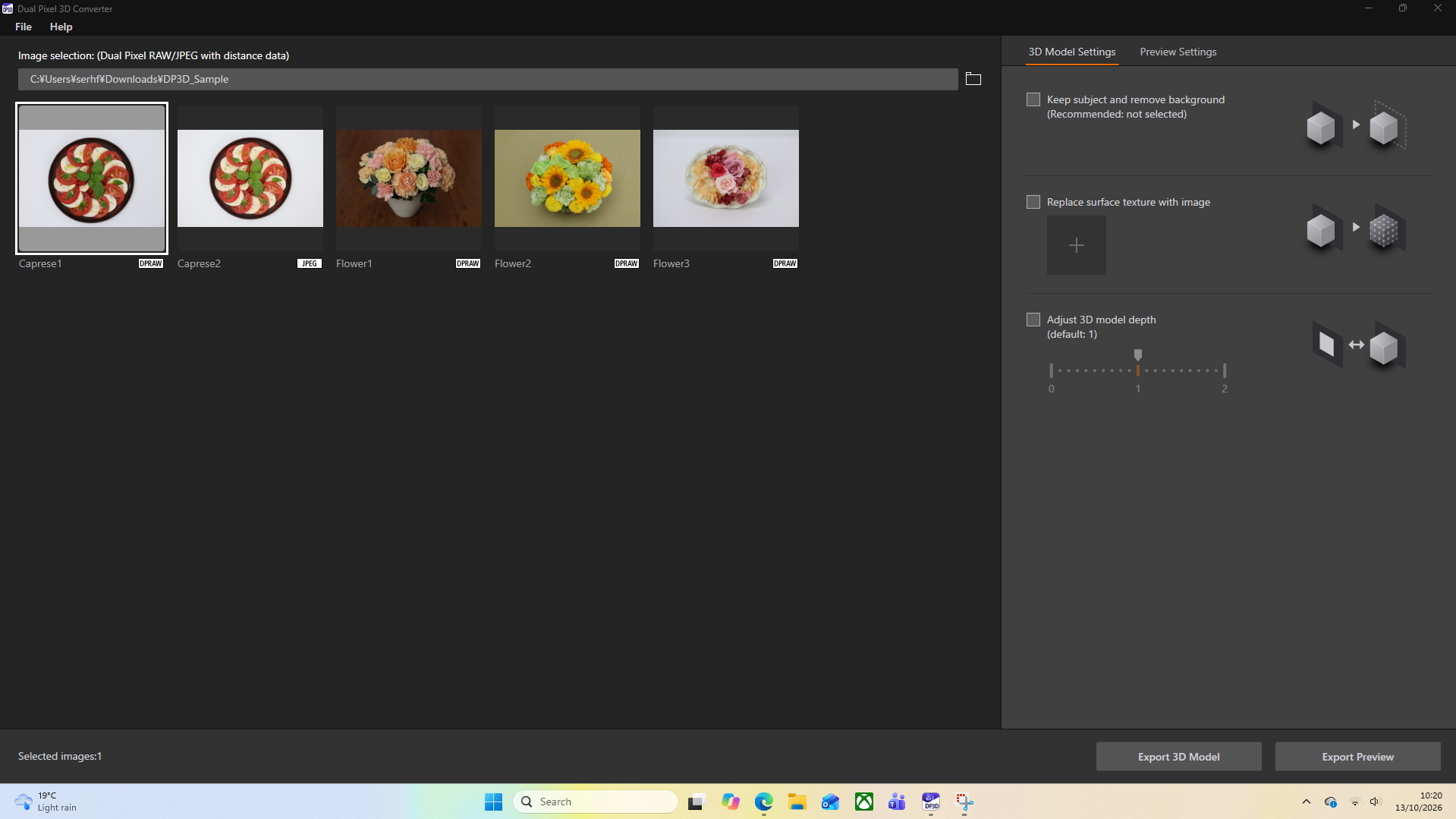
It’s also worth noting at the bottom of the same Canon site, you can download five sample images made up of a mix of food and flowers which you can play around with if you are yet to shoot with Dual Pixel RAW enabled, or perhaps you don’t own a Canon EOS mirrorless camera and what to see what all the fuss is about. Note, the sample files are downloaded as a DP3D _Sample.zip file and you’ll need to extract these files by right-clicking on the folder and choosing Extract before you can use these images in DP3D.
Creating 3D images in the DP3D app
The DP3D app allows users to fine-tune the degree of depth, making a more pronounced 3D effect or a more subtle ‘flat’ appearance. The technology also makes it easy to isolate your subject and remove or replace the background before outputting a 3D model or stereoscopic photo.
(Image credit: Dan Mold)
Dual Pixel RAW files and supported Canon EOS R8 Mark II JPEGs contain depth information derived from the slightly different views captured by the two photodiodes on each pixel. Using proprietary algorithms, Canon converts this phase-difference information into 3D shape data, which is combined with high-quality image data captured by selected EOS cameras as surface textures to create realistic and detailed 3D models.
Once you’ve loaded up DP3D you’ll need to click the folder icon at the top of the main window and then navigate to the folder where you’ve saved your Dual Pixel RAW files.
(Image credit: Dan Mold)
You have two main options – either create a 3D model which you can edit further in a 3D editor such as Blender, or you can create a Preview which creates a very short video with limited options, essentially doing a basic pan from left to right to show off the 3D depth effect. You also have options here to change the background, add a foreground and frame. You can also choose the quality of the video when you click Export Preview. Here you can also set the quality to High, Medium or Low quality (18, 8 or 4 Mbps), choose your own filename and where you want to save the video.
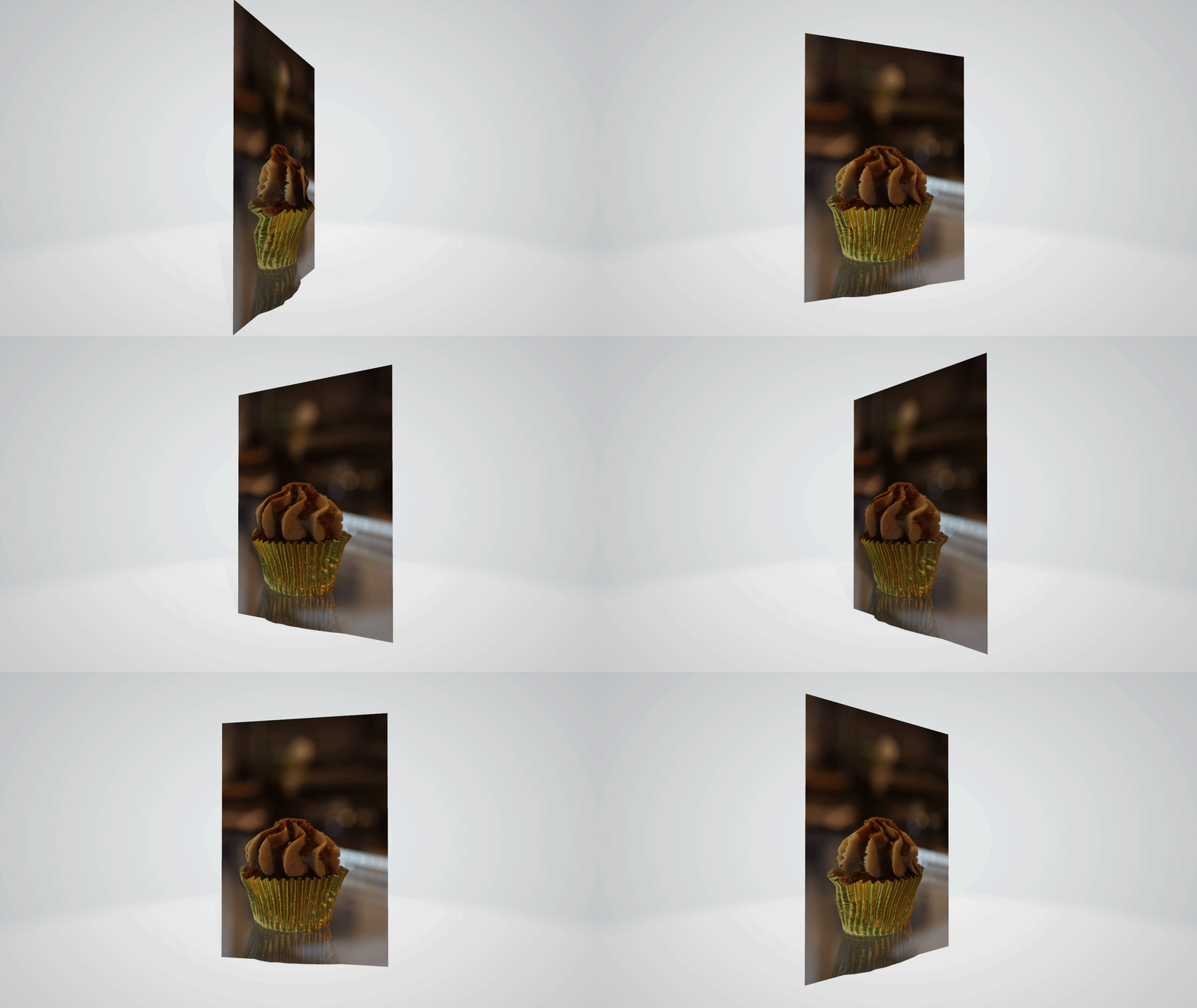
However, I found those options rather limiting within DP3D so I would instead click Export 3D Model where you’ll have the choice between OBJ and GLB files to edit further in your 3D editor of choice. You can also use Windows 3D viewer and even Preview on Mac to play around with these 3D files and explore the different angles produced by DP3D.
(Image credit: Dan Mold)
With the 3D file created you can use a program such as Windows 3D Viewer or Blender, which is free to download. In a program such as either of these options you’ll have way more options than DP3D for changing the angle, rotation and lighting, which is great for exporting still images. For videos, you’ll also be able to change the direction and duration of pans so you can get it looking perfect for what you need.
Conclusion
After playing around with DP3D for some time and with various pictures and subject matter, I think it’s fun and interesting that Canon has released it for free - after all, additional functionality to the cameras which we already own is certainly welcome.
However, the results have limited uses and more often than not look quite poor. Are there situations where somebody might need to get a little 3D animation from a 2D image? Sure — marketeers looking to animate food or product shots for videos and reels seems like a perfectly adequate use for Canon's new DP3D tech.
While it’s admirable that Canon is trying to squeeze the most out of the pixels taken in-camera, this is one of those situations where I sadly think AI can probably do it better.
Canon is trying to stretch and manipulate the pixels already there, whereas AI can create brand new pixels and frames based on what it thinks should be there, and that’s likely to create smoother results with fewer artefacts. For still images, the Rotate Object feature found in Photoshop Beta is likely to produce better results and is glimpse of what lies ahead in our editing futures.
from Latest from TechRadar US in Computing News https://ift.tt/m2CAB9g
via
A new NYT Strands puzzle appears at midnight each day for your time zone – which means that some people are always playing 'today's game' while others are playing 'yesterday's'. If you're looking for Saturday's puzzle instead then click here: NYT Strands hints and answers for Saturday, October 24 (game #965).
Strands is the NYT's latest word game after the likes of Wordle, Spelling Bee and Connections – and it's great fun. It can be difficult, though, so read on for my Strands hints.
Want more word-based fun? Then check out my NYT Connections today and Quordle today pages for hints and answers for those games, and Marc's Wordle today page for the original viral word game.
SPOILER WARNING: Information about NYT Strands today is below, so don't read on if you don't want to know the answers.
NYT Strands today (game #966) - hint #1 - today's theme
What is the theme of today's NYT Strands?
• Today's NYT Strands theme is… Something to build on
NYT Strands today (game #966) - hint #2 - clue words
Play any of these words to unlock the in-game hints system.
KNOT
STEEL
WORK
DRAW
SUNK
SLEET
LARD
NYT Strands today (game #966) - hint #3 - spangram letters
How many letters are in today's spangram?
• Spangram has 11 letters
NYT Strands today (game #966) - hint #4 - spangram position
What are two sides of the board that today's spangram touches?
• First side: bottom, 5th column
• Last side: bottom, 1st column
Right, the answers are below, so DO NOT SCROLL ANY FURTHER IF YOU DON'T WANT TO SEE THEM.
NYT Strands today (game #966) - the answers
(Image credit: New York Times)
The answers to today's Strands, game #966, are…
SCAFFOLDING
FRAMEWORK
STRUCTURE
SKELETON
SPANGRAM: FOUNDATIONS
My rating: Easy
My score: Perfect
I decided to take the theme literally and went hunting for FOUNDATIONS, which I was delighted to spot as a rare right-to-left, bottom-to-bottom spangram towering impressively across the board.
This was my 113th Spangram First.
From here, SCAFFOLDING was the only other construction word I knew — but I was able to build on my confident start with some easily spottable words.
Yesterday's NYT Strands answers (Saturday, October 24, game #965)
BASKET
WASHER
SINK
RACK
DETERGENT
IRON
SPANGRAM: LAUNDRYDAY
What is NYT Strands?
Strands is the NYT's not-so-new-any-more word game, following Wordle and Connections. It's now a fully fledged member of the NYT's games stable that has been running for a year and which can be played on the NYT Games site on desktop or mobile.
I've got a full guide to how to play NYT Strands, complete with tips for solving it, so check that out if you're struggling to beat it each day.
from Latest from TechRadar US in Gaming News https://ift.tt/QWcaEgn
via TECHNICAL SAFEER
An AI tool called Raven can cross-reference fixtures, fittings, and other interior details to find the location of a property
It pinpoints properties using data scraped from Airbnb and other sites
Raven was previously known as GeoSpy and was initially conceived to identify locations based on landmarks
A new AI tool that can identify a property’s location using interior photos has been publicized online. Already in use by law enforcement agencies in Florida and California, Raven uses AI to match fixtures and fittings and decorative elements from photos with information sourced online.
Following the publication of a video demonstrating the software, Raven has attracted attention from some of the websites it apparently uses to acquire the information it uses. The sites – which include Airbnb – seem to have concerns about how the data and images they collect is being used.
Raven’s existence could potentially be used to find the location of any property – assuming that its address and similar images already exist online.
Innocent? Your home is safe
Raven has been used by the LAPD and the Miami-Dade Sheriff's Office in Florida. Its main purpose so far has been in tackling human trafficking, but the software represents obvious privacy challenges which its creators seem to be sidestepping at this stage.
The most important takeaway is that as long as your home (or business premises) hasn’t been used for criminal activities and photos of its interior aren’t online, then you have nothing to worry about.
Daniel Heinen of Raven developers Graylark described the product as “purpose-built AI for the people working to find answers and protect lives.”
However, some of the websites that Raven uses to gather information have expressed concern. The video of Raven in action appears to show the software using both Zillow, Vrbo, and Airbnb, with the latter reviewing the situation. Zillow stated scraping its data was against its ToS.
These issues could prove to be a challenge to the successful use of Raven across a wider area.
Matching interiors
Raven essentially breaches privacy by providing the location of an interior photo. Assuming a similar photo of the same interior exists online with an address attached – such as on Airbnb or a property site – then Raven should be able to identify it.
Heinen doesn’t mention the privacy challenges in his LinkedIn post about Raven, instead focusing on the software’s “ability to geolocate interior images across millions of short-term rental units worldwide.”
While highlighting the use of short-term rentals for human trafficking, the post focuses on Raven’s USP: “For investigators, a photo or video from inside a property may be a critical lead, but without an address or location tag, knowing where to start can be difficult. Raven helps investigators match interior imagery to potential properties, turning visual clues into location leads they can review and verify.”
It would seem likely that for Raven to be embraced successfully by other police departments in the US and beyond, it would need to accept regional privacy laws and build partnerships with the companies it appears to be scraping.
from Latest from TechRadar US in Computing News https://ift.tt/L4ncMH9
via
Stranger Than Heaven director Mikinobu Abe says the game's Showbiz system was "a real challenge" for RGG Studio
Abe says lots of research was put into finding out what a show promoter does and how to depict that in-game
Abe adds that "At some point we did have a small rhythm game," but the idea didn't match the team's vision
Stranger Than Heavendirector Mikinobu Abe has revealed how RGG Studio designed the game's Showbiz narrative system and how difficult it was to get right.
In an interview with TechRadar Gaming, Abe said the Showbiz, an entertainment management system requiring the main character, Makoto Daito, to build a business, find sources of inspiration for music, and plan productions as a promoter, "was a real challenge for us."
The director explained that RGG started by asking: what does a promoter actually do? Because "you know what a singer does, and you know what a band does, but you don't exactly know what a promoter does in the music industry," so research began from there.
Abe revealed that "At some point we did have a small rhythm game, but it didn't exactly match the feeling that you're promoting a show," so the team went back to the whiteboard phase to try different things.
"One thing that we noticed is that a promoter is the person who brings in not just the money, but also the inspiration and the whole vision of the show," Abe said. "We thought that's an interesting aspect that we can put into this game."
In Stranger Than Heaven, players can walk around cities and interact with things in the environment, like a grandfather clock or a bonfire, and collect sounds as inspiration for music. Daito can then take these samples and collaborate with a composer to create new music and plan a production for the singer and band.
"The inspiration sources are basically like when you have a certain job, you always have these antennas looking for something," Abe said. "So, if you're a musician, you always have this antenna for the music you're hearing, and that can inspire people to create new stuff, and that was no different for Makoto as well.
Abe added, "That's why this game system of finding and then using that inspiration to create music came to life in the game."
A new report claims that Amazon is buying up more AI GPU racks than it can deploy in data centers
An analyst links this report to Nvidia's GeForce GPU supply woes, theorizing that there's a connection
The contention is that Nvidia is deliberately 'channel stuffing' or in other words, pushing an excess of AI GPUs to the detriment of gaming GPU chips
Nvidia's supply issues with its gaming GPUs are seemingly the result of a strategy to get AI giants to stock up on more graphics chips than they can handle, if fresh reports are to be believed.
You can't have failed to notice the stock issues around Nvidia's GeForce GPUs, and the spike in prices that has happened over the past few months, particularly for higher-end graphics cards.
Business Insider informs us that Amazon (or rather AWS) is buying more Nvidia GPUs than it can deploy. Apparently, racks of the AI graphics cards are being kept unused in holding warehouses until there's power available at the data centers where they'll be used (electricity capacity, not space, is the issue here).
Amazon is paying out huge sums for these GB300 racks from Nvidia, and according to an internal email that Business Insider got hold of, a new 'Early Rack Receipt' process (buying these GPUs upfront, before they're installed) saw some $5 billion worth of server racks paid for in August 2026. Seemingly $3 billion more are on order every month for the "foreseeable future" going by another email.
We're told one AWS team didn't have a "clear forecasted path" for getting the purchased racks installed — in other words, they're not even sure when these GPUs might be used.
Zitron's argument is based on a key phrase in the Business Insider report, where the author states that the reason for the switch in policy — Amazon only used to pay for racks when they were installed in a data center — is that "Amazon has to compete more for scarce resources as it jockeys with rivals for access to Nvidia GPUs and other AI components."
The conclusion Zitron draws is that this is basically indicating that Nvidia is making Amazon, and others buying up AI GPUs, compete with each other by agreeing to order a whole pile of them there and then — more than they possibly need — otherwise they won't get their allocation (presumably).
Analysis: GPU misery is clear enough to see
(Image credit: Shutterstock / aslysun)
In short, these AI GPUs aren't actually needed as such — not by Amazon in this quantity, as per the Business Insider report — but Nvidia is effectively strong-arming the company into buying the chips, or as Zitron puts it, this is "deliberate channel stuffing." Meaning Nvidia is forcing this AI demand artificially to the seeming detriment of GeForce GPUs, with lesser chip supply for those gaming cards causing price inflation and general misery for gamers.
Obviously we need to take this with a good deal of caution — that goes for the initial report from Business Insider, and doubly so with the theorizing that Zitron applies on top of that article.
There's no denying, however, that we have witnessed a frustrating shortage of consumer GPUs, and in particular Nvidia's high-end gaming graphics cards have become painfully thin on the ground — and pricey. The RTX 5090 is either unobtainable, save through third-party marketplace sellers trying to gouge you out of the best part of 10 grand (in the US), or it's hideously expensive to the tune of over £6,000 in the UK, for example.
What's worse is the RTX 5080 is now getting ridiculously pricey too, reaching £1,400 in the UK. And in the US on Newegg, there's now only one model for sale (direct from the retailer) — and it'll set you back $2,000. It's all getting silly, frankly, and with rumors that the RTX 5090 is being discontinued doing the rounds — speculation Nvidia has denied, I should make clear — it's currently a disappointingly gloomy picture for GPUs.
The expectation is that matters are only going to get worse for RAM, SSDs, and GPUs, as next year rolls into town — and that makes all the above theorizing seem a bit more plausible. It's certainly clear that Nvidia's priority is AI GPUs rather than GeForce graphics cards because of the profits involved with AI, but of course, Team Green is a business — so what do we expect? Prioritization is one thing, though, and the levelled accusation of the practice of 'channel stuffing' is entirely another.
from Latest from TechRadar US in Computing News https://ift.tt/IH7egw8
via
Stranger Than Heaven director Mikinobu Abe says RGG Studios did a lot of "difficult" research to depict the game's many cities across different time periods
However, Abe says "historical accuracy wasn't the goal from the very beginning," and the team took creative liberties
He says there is a lot of "fiction" woven through the cities for the player experience
RGG Studio did plenty of research for its multi-era action role-playing game, Stranger Than Heaven, butdirector Mikinobu Abe has said historical accuracy wasn't the end goal.
In a discussion with TechRadar Gaming about the early stages of development, Abe confirmed that a story spanning 50 years and five cities in Japan required a lot of research, which "itself was really difficult," and that RGG visited all the cities depicted in the game and libraries for material.
"No one knows what it was like back in 1915 Kokura, or 1929 Kure," Abe said. "So, we had to dig into a lot of our pictures, and we visited a lot of museums. We even bought a lot of books that were published back then, or magazines that were published back then, and read every single one of them. There was one time that bugs were coming out of them, which was not good to have in the office! We did a lot of research like that."
However, as much as research was vital to get a sense of the time periods RGG wanted to depict, the director said "historical accuracy wasn't the goal from the very beginning," and the team took creative liberties.
"We took a lot of inspiration from what we researched, but we wanted to depict the city in a way that we feel really represents the video game experience that we want the player to have," Abe explained. "There's a lot of fiction within the cities, but we wanted to capture the tone of what it could have been like or how it could have felt to be in that place."
It wasn't just historical research; Abe said he and the art director, Daishi Kanaya, researched paintings, vintage lenses, and film that were created during these decades, and that they "took a lot of inspiration from the equipment side of things," like what brush artists used when drawing at the time.
"We took a lot of inspiration from those and re-imagined how we, as creators in 2026, would use that equipment and create this new vibe or atmosphere for the game," he said. "That's just how this older colour, and the look, and the tone, and the atmosphere of the city came to life.
"I don't think 1915 Kokura was that populated or was that big of a city, but you know, we really wanted to capture the essence and humanise it in a way that we feel like it's really entertaining for people to play."
A new NYT Strands puzzle appears at midnight each day for your time zone – which means that some people are always playing 'today's game' while others are playing 'yesterday's'. If you're looking for Thursday's puzzle instead then click here: NYT Strands hints and answers for Thursday, October 22 (game #963).
Strands is the NYT's latest word game after the likes of Wordle, Spelling Bee and Connections – and it's great fun. It can be difficult, though, so read on for my Strands hints.
Want more word-based fun? Then check out my NYT Connections today and Quordle today pages for hints and answers for those games, and Marc's Wordle today page for the original viral word game.
SPOILER WARNING: Information about NYT Strands today is below, so don't read on if you don't want to know the answers.
NYT Strands today (game #964) - hint #1 - today's theme
What is the theme of today's NYT Strands?
• Today's NYT Strands theme is… None of your beeswax!
NYT Strands today (game #964) - hint #2 - clue words
Play any of these words to unlock the in-game hints system.
BEAVER
SPRING
NOSE
PRIDE
SPONGY
SITE
VEST
NYT Strands today (game #964) - hint #3 - spangram letters
How many letters are in today's spangram?
• Spangram has 8 letters
NYT Strands today (game #964) - hint #4 - spangram position
What are two sides of the board that today's spangram touches?
• First side: left, 1st row
• Last side: right, 6th row
Right, the answers are below, so DO NOT SCROLL ANY FURTHER IF YOU DON'T WANT TO SEE THEM.
NYT Strands today (game #964) - the answers
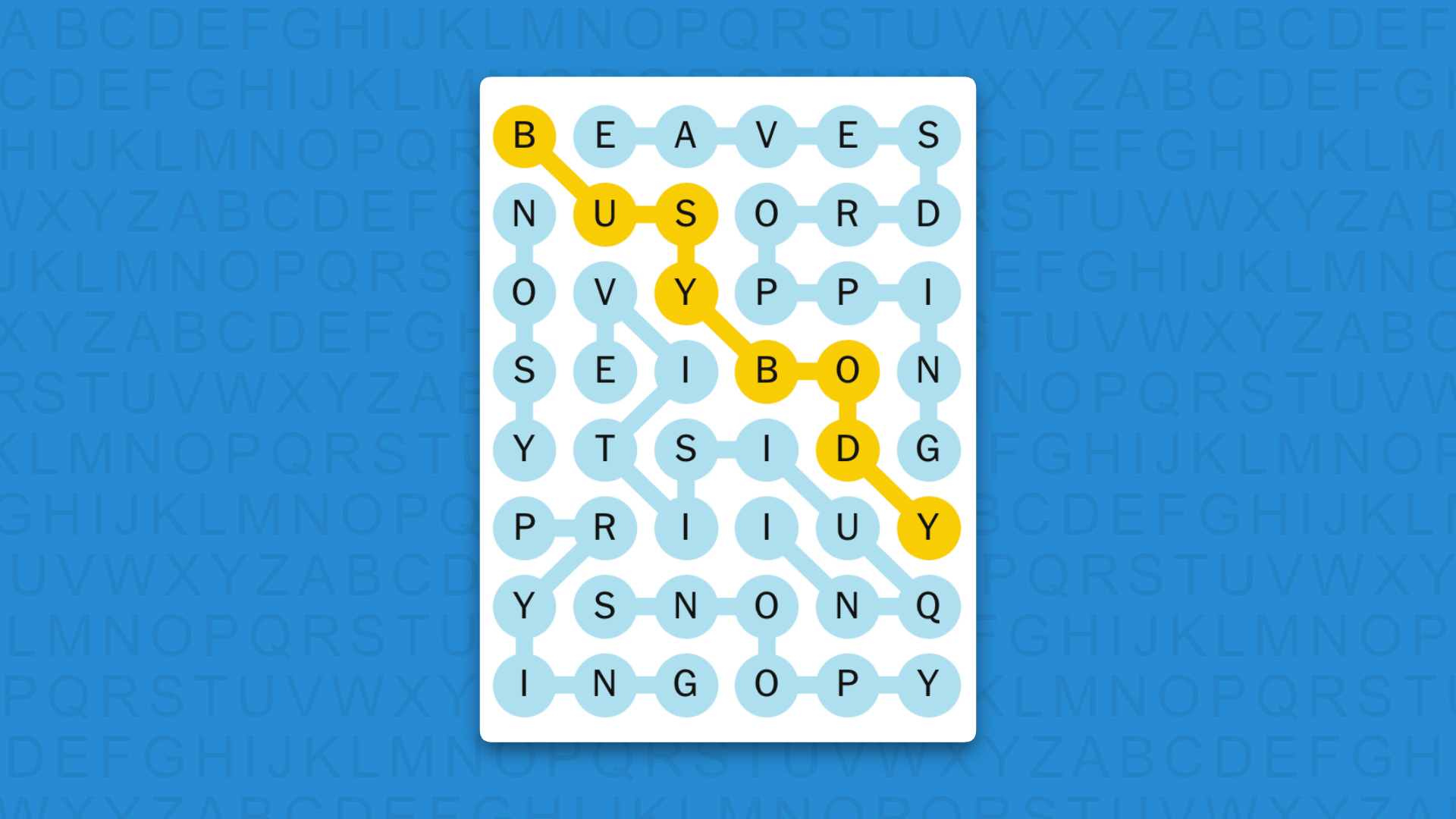
(Image credit: New York Times)
The answers to today's Strands, game #964, are…
NOSY
EAVESDROPPING
INQUISITIVE
SNOOPY
PRYING
SPANGRAM: BUSYBODY
My rating: Hard
My score: Perfect
Despite not needing any hints, I’m classifying this as a tricky game due to the length of several game words, including the WHOPPING 13-letter EAVESDROPPING.
INQUISITIVE also caused me some issues connecting it all together.
My main triumph, though, was spotting the Spangram First — an achievement that is not essential to enjoying Strands, but definitely mini-fistpump worthy.
Yesterday's NYT Strands answers (Thursday, October 22, game #963)
KINFOLK
OFFSPRING
BLOOD
BRETHREN
ANCESTORS
SPANGRAM: FAMILYTIES
What is NYT Strands?
Strands is the NYT's not-so-new-any-more word game, following Wordle and Connections. It's now a fully fledged member of the NYT's games stable that has been running for a year and which can be played on the NYT Games site on desktop or mobile.
I've got a full guide to how to play NYT Strands, complete with tips for solving it, so check that out if you're struggling to beat it each day.
from Latest from TechRadar US in Gaming News https://ift.tt/C1OUdBX
via TECHNICAL SAFEER
Microsoft collaborated with the Japanese National Police Agency to tackle Chinese-language cybercrime “app stores”
The YAM Store, CoGUI, and Iron Man have targeted people in more than 150 countries
Microsoft is working with law enforcement agencies worldwide to take down illegal operations that target businesses and individuals
Microsoft has announced a successful operation with the Japanese National Police Agency in which a collection of cybercrime app stores were disrupted. Investigating fraudulent, scam messages targeting Japanese businesses and citizens, the operation uncovered a multi-faceted criminal marketplace, with three key elements.
The YAM Store, CoGUI, and Iron Man had targeted 75,000 organizations across more than 150 countries worldwide, sent over one billion malicious communications promoting scams, and generated millions of dollars for the criminals behind them. Furthermore, 750 million messages were aimed at Microsoft’s own customers.
Alongside the Japanese authorities, Cloudflare, Oracle, Proofpoint, Resecurity, and TRM Labs were also involved in the operation.
Impersonation templates
Exploring the cybercrime ecosystem targeting Japanese businesses, investigators found the trio of the YAM Store, CoGUI, and Iron Man. Investigators found these provided a route into a cybercrime ecosystem for cybercriminals.
The environment was providing criminals with pre-fabricated fake websites and messages, designed to be used to fool targets into thinking they were interacting with the genuine article. Amazon was among the faked sites, on sale so scammers could simply host convincing pages to steal login and payment credentials, without any need to hire their own coder. Other spoofs on sale included government agencies, financial institutions, and other well-known companies.
Security filtering software was initially unable to handle the CoGUI phishing-as-a-service (Phaas) framework as it employed some sophisticated methods to avoid detection, including browser fingerprinting and geofencing.
What is interesting to note is the role these facilities played for the distribution of cybercrime assets. CoGUI was apparently targeting Japan and US victims, but during the course of the investigation, was replaced by a new service, Iron Man.
The YAM Store
While all three components were already known to Microsoft and the authorities, it took a concerted effort to infiltrate the network of cybercriminals using the services. They were hosted in a wholly Chinese-language environment, requiring native-speakers to be added to the investigating team, and gain access to the underground cybercrime marketplace known as the YAM Store.
Microsoft assigned a tracking number Storm-3119 to the marketplace, which it describes as an “Initial Access Broker.” It was set up to provide its customers with “compromised or fraudulently obtained environments in providers like Microsoft and Google.”
While it may be expected for compromised software to be on the radar of its publishers, the creator(s) of the YAM Store had a workaround. It was able to keep its inventory fresh by using automation. This identified “expired environment or organization names and leverages legitimate customer information associated with them to help circumvent existing detections.”
Microsoft has seized domains associated with the YAM/CoGUI/Iron Man infrastructure, and either blocked or redirected them.
from Latest from TechRadar US in Computing News https://ift.tt/dXgPbMr
via
A new NYT Strands puzzle appears at midnight each day for your time zone – which means that some people are always playing 'today's game' while others are playing 'yesterday's'. If you're looking for Wednesday's puzzle instead then click here: NYT Strands hints and answers for Wednesday, October 21 (game #962).
Strands is the NYT's latest word game after the likes of Wordle, Spelling Bee and Connections – and it's great fun. It can be difficult, though, so read on for my Strands hints.
Want more word-based fun? Then check out my NYT Connections today and Quordle today pages for hints and answers for those games, and Marc's Wordle today page for the original viral word game.
SPOILER WARNING: Information about NYT Strands today is below, so don't read on if you don't want to know the answers.
NYT Strands today (game #963) - hint #1 - today's theme
What is the theme of today's NYT Strands?
• Today's NYT Strands theme is… Any relation?
NYT Strands today (game #963) - hint #2 - clue words
Play any of these words to unlock the in-game hints system.
MOOD
FLOG
TERRY
BEER
THERE
MILE
NYT Strands today (game #963) - hint #3 - spangram letters
How many letters are in today's spangram?
• Spangram has 10 letters
NYT Strands today (game #963) - hint #4 - spangram position
What are two sides of the board that today's spangram touches?
• First side: top, 1st column
• Last side: bottom, 6th column
Right, the answers are below, so DO NOT SCROLL ANY FURTHER IF YOU DON'T WANT TO SEE THEM.
NYT Strands today (game #963) - the answers
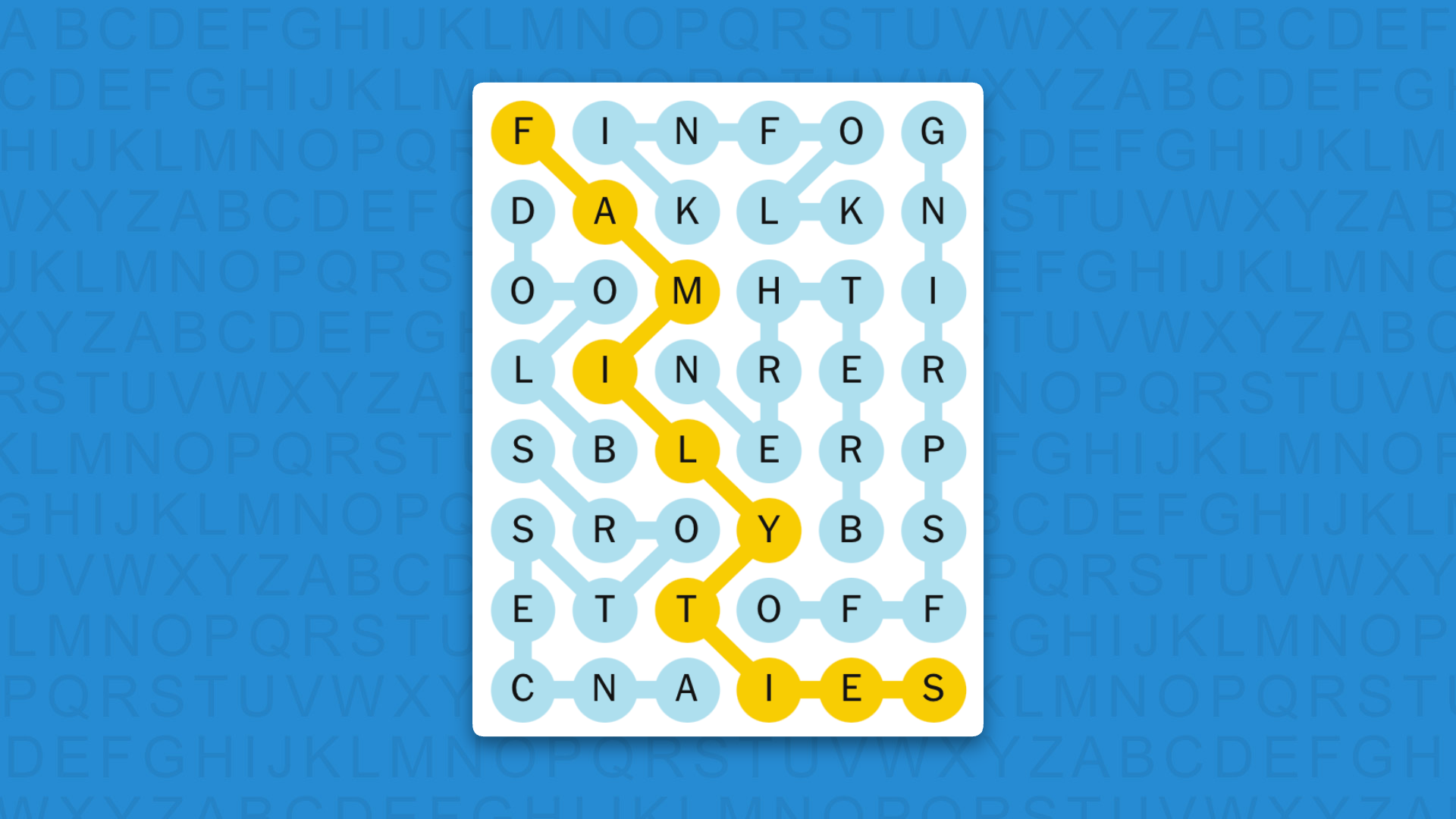
(Image credit: New York Times)
The answers to today's Strands, game #963, are…
KINFOLK
OFFSPRING
BLOOD
BRETHREN
ANCESTORS
SPANGRAM: FAMILYTIES
My rating: Hard
My score: 1 hint
This was one of those days where my mind was elsewhere.
I struggled even though I had a strong sense of the words we would be looking for, although to begin with I did search for mother, father and auntie. Seeing KINFOLK and OFFSPRING ended that avenue.
I also labored over the spangram; despite the fact that I connected “family”, I missed the next four letters that made it FAMILYTIES.
I also had to use a hint after my initial burst; BLOOD seemed so obvious, but it had completely passed me by.
Yesterday's NYT Strands answers (Wednesday, October 21, game #962)
BOXES
LUGGAGE
TRUNKS
YEARBOOKS
DECORATIONS
SPANGRAM: INTHEATTIC
What is NYT Strands?
Strands is the NYT's not-so-new-any-more word game, following Wordle and Connections. It's now a fully fledged member of the NYT's games stable that has been running for a year and which can be played on the NYT Games site on desktop or mobile.
I've got a full guide to how to play NYT Strands, complete with tips for solving it, so check that out if you're struggling to beat it each day.
from Latest from TechRadar US in Gaming News https://ift.tt/61d852S
via TECHNICAL SAFEER
Memorizing all of the past Wordle answers is nearly impossible – after all, there have now been more than 1,900 of them. And even though Wordle answers do now repeat (see below), it can still be helpful to know what's gone before.
That's partly because the early evidence is that answers are not all that likely to appear twice; since Wordle changed its strategy in early February they've only been turning up about every 10-15 days, so new words are still far more common than old ones.
Repeated answers
As you probably know, Wordle is now repeating answers. I've added an asterisk next to any solutions that have appeared more than once. If any are repeated twice I'll add a second asterisk and so on. I've also included a standalone section that lists all repeats. Jump to it here.
But even outside of that, it can be interesting to see what happened in the past. Plus, knowing the kind of words that might appear can help you decide what to play today.
What you need then, is a list of past Wordle answers, and that's what I've made for you here. It's organized by month and you can simply search the page to see whether the word you're thinking of has already been used. It won't be a guarantee that it won't appear again, but it might help.
Below you'll find a list of every Wordle so far — all 1,949 of them (and counting!)
I've first organized the answers alphabetically, and then by month starting with the most recent. You can use the menus on the side (on desktop) or above (on mobile) to jump straight to the month you want. This year, 2025 and 2024 are on this page, and there's a second page with 2023, 2022 and 2021 on it (and the alphabetical list is on both pages).
If you're trying to find out whether a specific word has already been an answer, there are easy ways to search for it:
Windows: click CTRL+F
macOS: click CMD+F
iOS: click Share (the box with the arrow), then 'Find on page'
Android: click the three dots in the top-right then 'Find in page'
In each case, simply type in the word you're looking for, and if it has already been an answer you can use the arrows to navigate to it.
One of the key things about Wordle is that everyone gets the same answer each day. Or is it? There have been four occasions when the game has served up two different solutions, causing no end of consternation among players.
The first two were victims of the New York Times' purchase of the game in February 2022. The NYT removed around a dozen words that it decided were too difficult for players, or that were in some way controversial.
However, at that time people could play either via the NYT's games site, or via the original Wordle website created by Josh Wardle. And unfortunately, the changes made by the NYT didn't always filter through correctly to the original version.
The result was that on February 15, 2022 some people got AROMA and some the much harder AGORA for puzzle #241. Then on March 30, the same thing happened with STOVE and HARRY for game #284; the NYT thought people would only consider HARRY to be a name, and not a verb (as in to harrass), so it removed it.
The problem reoccurred in May 2022. On May 10 (game #324), the NYT removed the word FETUS in the wake of the US Supreme Court's decision to repeal Roe vs Wade, deeming it too controversial. Instead, most players got SHINE. The next day, some players got GECKO while others received BUTCH, due to the NYT's servers not yet having reset for everyone from the previous day's change.
Game
Date
Correct answer
Alternative answer
325
Tuesday, 10 May 2022
GECKO
BUTCH
324
Monday, 9 May 2022
SHINE
FETUS
284
Wednesday, 30 March 2022
STOVE
HARRY
241
Tuesday, 15 February 2022
AROMA
AGORA
from Latest from TechRadar US in Gaming News https://ift.tt/9IsVZwR
via TECHNICAL SAFEER